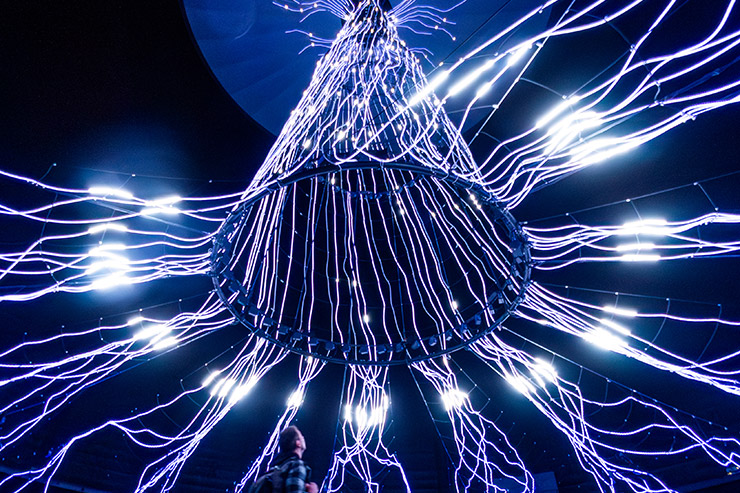

Der Baum (The Tree)


ProjectDer Baum (The Tree)LocationGasometer Oberhausen, Oberhausen, GermanyLighting DesignerArs Electronica Solutions; Garamantis GmbH; zitras- Gesellschaft für sichere Höhenarbeiten mbH; geo - Die Luftwerker Robert Meyknecht e.K.AcousticianRupert HuberSystems IntegratorArs Electronica Solutions; Tennagels; Zitras; geo- Die LuftwerkerSubmitted ByArs Electronica Solutions

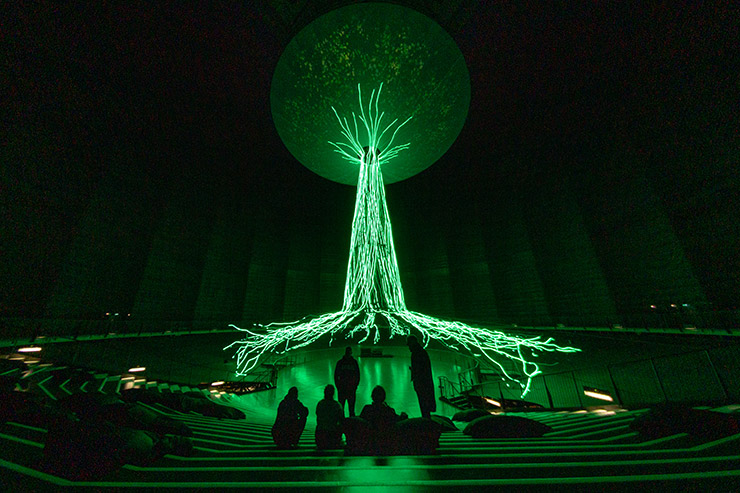
The project “The Tree” serves as the center-piece of the exhibition “Forest Worlds” at the Gasometer Oberhausen. The client’s goal was to create an immersive, emotionally engaging, and scientifically grounded experience that raises visitor awareness of the importance of global forest ecosystems.

The installation was designed to leverage the monumentality of the Gasometer’s architecture, taking visitors on an impressive journey from the root system to the treetop. Key requirements included a strong visual impact, innovative communication of complex content, and a unique visitor experience with high memorability.

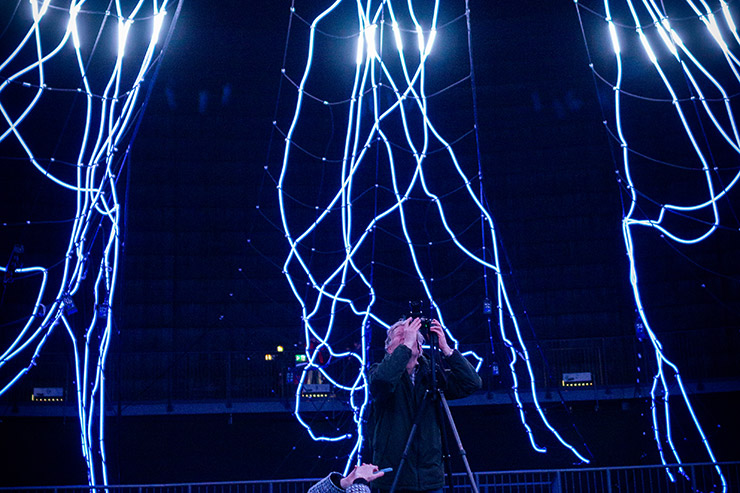
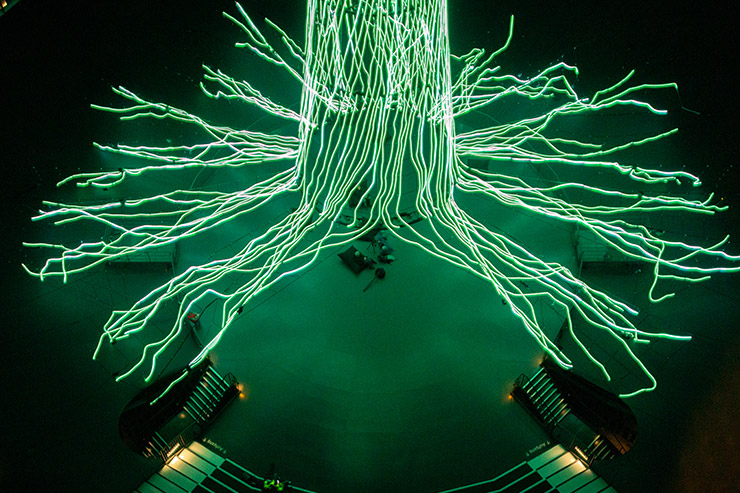
The installation is built on an impressive network of 2.8 km of RGB LED strips, arranged in a full 360° configuration and comprising a total of 42,892 individually addressable pixels. These pixels are controlled across approximately 300 DMX universes, allowing for precise, finely tuned manipulation of light sequences. In total, the installation contains 343,136 individual LED diodes.

Thanks to this technical precision, the LED strips can be arranged organically along the tree structure—from roots through trunk and branches to the canopy—while enabling complex colour transitions and dynamic motion effects. The combination of a high pixel count, numerous DMX universes, and individual control creates flowing, vibrant lightscapes that transform the space into a fully immersive, multimedia experience.

The content displayed on the LED strips was generated in Unity. This approach was absolutely necessary to adapt the visuals perfectly to the spatial conditions within the limited setup time, as a full-scale test installation of this size was not feasible.

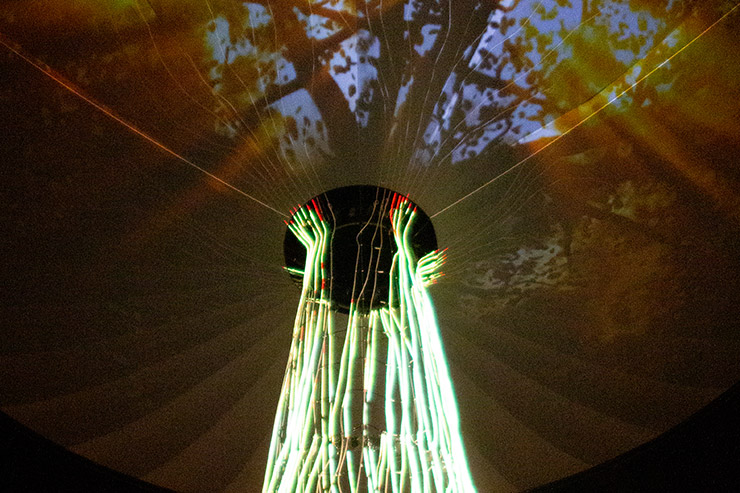
For the treetop, an additional video was created in After Effects to enable complex visual effects and smooth motion sequences.

All elements were then integrated via Map Mapper as a central control system, allowing generative content, pre-rendered sequences, and the physical structure of the LED strips to merge into a fully synchronised, immersive experience.

The tree’s substructure was realised as an innovative steel cable net, a technique typically used only in playground climbing structures. Precisely connected net segments with steel rings form the organic shape of the 35-meter-high tree, seamlessly linking roots, trunk, branches, and canopy.

This novel substructure allows the 2.8 km of LED strips to be arranged organically, bringing the entire sculpture to life. The canopy is formed by a 30-meter-wide truss ring with integrated gauze, onto which six 4K projectors cast their imagery. These projections onto the gauze expand the visual presence of the canopy and dynamically simulate natural elements such as light, seasonal changes, and movement.

A particular technical challenge was the structural engineering: the approximately 11 tonnes installation had to be safely suspended within the Gasometer and statically verified to ensure maximum stability and safety. The combination of innovative engineering, audiovisual technology, and artistic vision creates an immersive experience that is both visually striking and emotionally compelling.

A specially composed soundtrack was developed for the 15-minute loop, seamlessly complementing the visual presentation. Various audio tracks were strategically placed on the 11 active loudspeakers distributed throughout the space, creating an immersive, three-dimensional sound field that completely draws visitors into the installation.

A particular challenge was the architecture of the gasometer: the massive steel structure produces a 16-second reverberation time, which significantly influenced both the composition and the timing of the individual sound events. To ensure perfect synchronisation of image and sound, the audio was precisely adjusted on-site to match the visual presentation and timed frame by frame.

The result is a sound environment that not only enhances the atmosphere but also uniquely intensifies the emotional impact of the light and video installation.

The realisation of “The Tree” at the Gasometer Oberhausen presented the project team with several extraordinary challenges. One of the most significant was the scale of the space: with a height of over 100 meters and a cylindrical structure, the Gasometer required tailor-made technical solutions for installation, structural stability, and media integration. The installation needed to be safely mounted at great height while remaining visually impactful from every perspective within the space.

Another major challenge was the precise coordination of the various audiovisual elements. LED light structures, projections onto gauze, and spatialized sound all had to be perfectly synchronised to achieve a seamless, immersive effect. This was accomplished through a central control architecture and extensive on-site testing and fine-tuning.
Integration with the existing architecture also played a key role. The industrial character of the Gasometer was intentionally preserved and incorporated into the experience rather than obscured, requiring close collaboration between creative, technical, and architectural teams.

Additionally, the installation needed to be robust and low-maintenance to ensure long-term operation under high visitor volumes. The use of high-quality components and thoughtfully designed accessibility for maintenance made this possible, guaranteeing reliable performance throughout the exhibition period.

“The Tree” is an exceptional immersive experience that seamlessly merges audiovisual technology, architecture, and content-driven storytelling into a unique, cohesive installation.

This monumental light and spatial sculpture makes the hidden dynamics of a tree tangible and visible for visitors in an entirely unprecedented way. Through the combination of lighting, projections, and spatialized sound, a multisensory experience is created that is both emotionally moving and scientifically informative, making complex ecological processes understandable.

Particularly remarkable is the innovative use of the Gasometer as an exhibition space. The building’s monumental scale is not only utilized but actively integrated into the dramaturgy of the installation, creating a presentation that is globally unique and offering visitors a completely new perspective on nature.

The project also stands out for its content relevance, raising awareness of the importance of forests and their fragile ecosystems, and encouraging societal reflection on environmental issues. By combining science, art, and technology, the installation clearly distinguishes itself from traditional exhibitions.

Furthermore, “The Tree” demonstrates the highest standards of planning and execution. The precise synchronization of all AV components, the meticulous design of visual content, and the sustainable, operationally reliable implementation set new benchmarks for immersive environments.

Overall, “The Tree” unites innovation, technical excellence, artistic vision, and societal significance. Visitors experience the inner dynamics of a tree in an entirely new, profound way—an immersive journey that resonates long after the visit and fully meets the criteria for a MONDO-DR Award.