
DCU Center


ProjectDCU CenterLocationWorcester, Massachusetts, USAAcousticianWJHWSystems IntegratorMetropolitan InteractiveSubmitted ByEAW

The DCU Center sought to replace its aging sound system, which could no longer meet the technical demands of its 14,000‑seat arena or the wide range of events it hosts. The brief called for a powerful, efficient and highly adaptable solution that could deliver consistent clarity for everything from sports to concerts to graduations.

Metropolitan Interactive, alongside WJHW, Ostrow Electric, and EAW, designed and installed a customized ADAPTive audio system featuring Anna and Otto modules with supplemental coverage. The project aimed to improve intelligibility, streamline operations, reduce reverb and future‑proof the venue’s production capabilities.

Upgrading the DCU Center’s sound system required navigating several significant challenges tied to the venue’s scale, acoustics and event diversity. The arena’s aging system couldn’t keep pace with the quality of events it hosted, creating an immediate need for a solution that could deliver clarity and power across up to 14,000 seats while remaining efficient to operate.

One of the primary challenges was the sheer size and acoustic complexity of the space. Large arenas often struggle with uneven coverage, long reverb tails and intelligibility issues, especially when hosting drastically different event types. The DCU Center required a fully customized audio solution built to address the architectural and acoustic challenges of the DCU Center. Achieving uniform coverage across all seating zones—lower bowl, mid‑level and upper seating—was a core technical hurdle.

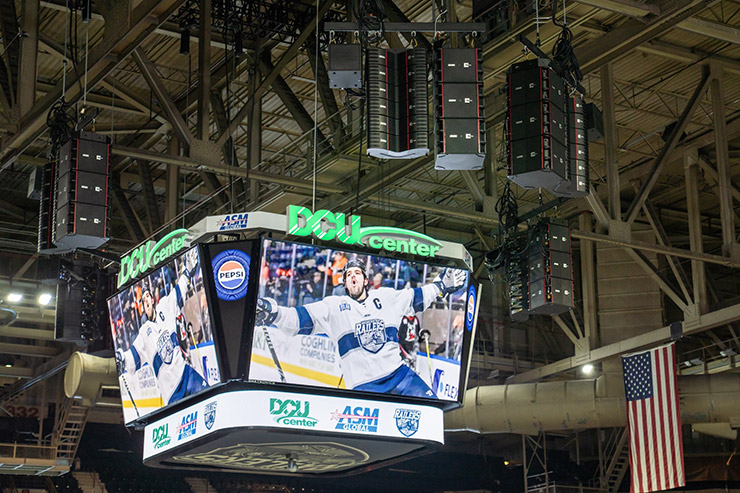
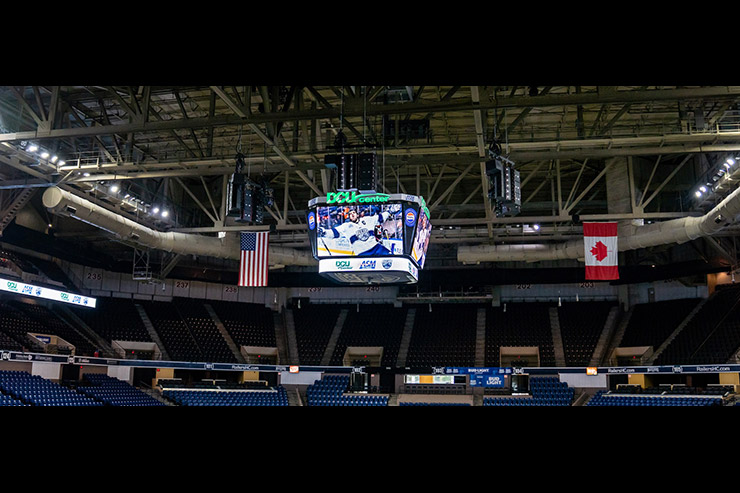
This was addressed through the deployment of EAW’s ADAPTive Series, including six main hangs of six Anna modules and three Otto subwoofers each. The ADAPTive technology allowed the team to digitally tailor coverage to the venue’s geometry, overcoming the challenge of delivering consistent sound across a large, asymmetrical environment. The system’s ability to change coverage to focus full system energy on only the lower or mid‑level seating without the demand of addressing the array mechanically solved another major challenge: supporting both full‑arena events and smaller configurations without physically re‑aiming the system.

Another challenge was operational flexibility. The venue frequently hosts graduations, family shows and sports, each requiring different system layouts. Traditionally, reconfiguring clusters is labor‑intensive, but the ADAPTive system enabled the DCU Center to easily redeploy the existing clusters with minimal manpower, addressing the logistical challenge of rapid event turnover.

Finally, the installation team had to ensure the system met modern production expectations. Artists and engineers increasingly demand clean, controlled environments, and the previous system struggled to meet those standards. The new system’s precision and efficiency resolved this, with production teams noting how easy it is to achieve a clean mix in the space.

Through advanced modeling, ADAPTive technology and collaborative design, the installation overcame every challenge to deliver a future‑ready audio experience.

The DCU Center’s audio upgrade stands out as a model of technical innovation, collaborative execution and transformative impact, which are all qualities that define an award‑winning project. For a venue that has served as a cultural anchor for over 40 years, the challenge was substantial; its aging sound system couldn’t keep pace with the quality of events it hosted, limiting both production capability and guest experience.

What makes this project exceptional is the scale and precision of the solution. The DCU Center required a system powerful enough for 14,000 seats yet flexible enough to support concerts, hockey games, graduations and family events. EAW, WJHW, Ostrow Electric and Metropolitan Interactive delivered a fully customized ADAPTive system designed specifically to overcome the venue’s architectural and acoustic complexities. The installation features six main hangs of Anna modules and Otto subwoofers—36 Anna and 18 Otto in total—supported by QX300 and MK2300 loudspeakers to ensure detailed coverage across every seating zone.

The project’s standout achievement is the ADAPTive technology itself. Unlike traditional systems, which require mechanical re‑aiming or physical reconfiguration, the new system can digitally reshape coverage to match each event. It can focus full system energy on only the lower or mid‑level seating without the demand of addressing the array mechanically, reducing reverb and improving intelligibility for smaller events while maintaining full‑arena power when needed. This level of flexibility is rare in large‑venue installations and directly elevates operational efficiency.

Another award‑worthy aspect is the system’s redeploy ability. The DCU Center can now reposition clusters into an end‑zone configuration with minimal manpower, a major advantage for a venue with rapid event turnover.

Finally, the project’s success is validated by its users. Guest feedback has been overwhelmingly positive, and artists and production teams consistently highlight how easy it is to achieve a clean mix in the space. This demonstrates not just technical excellence, but meaningful real‑world impact.