
Radical Acts of Unrelenting Beauty


ProjectRadical Acts of Unrelenting BeautyLocationLouvre's Cour MarlyLighting DesignerLumen and ForgeInstallerLumen and ForgeSubmitted ByLumen and Forge

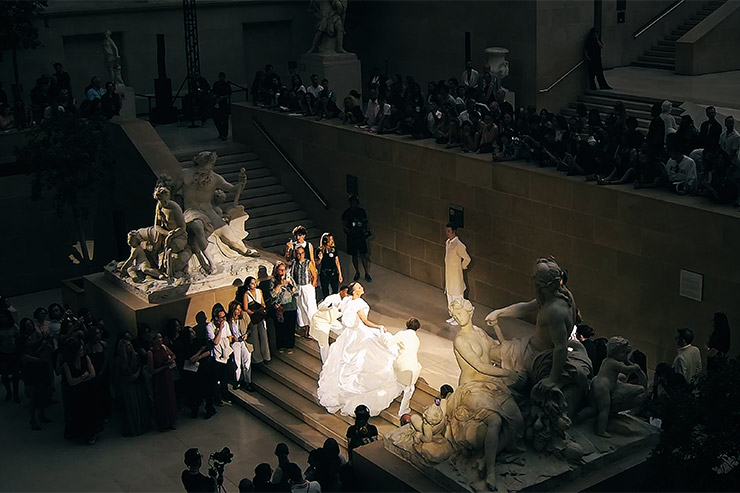
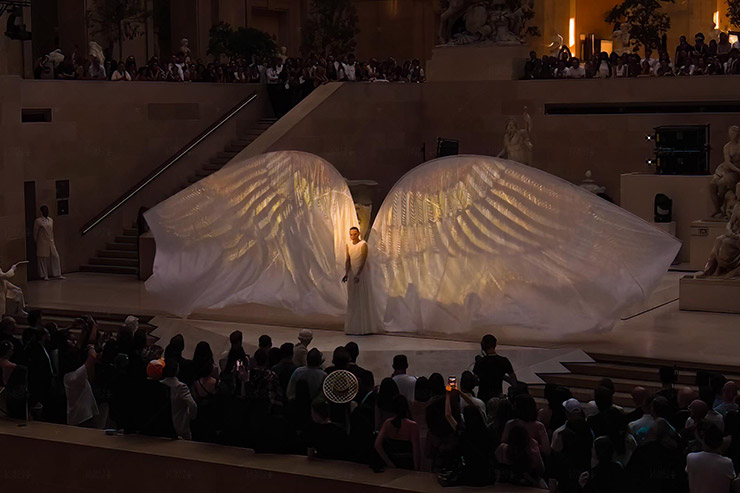
Jordan Roth commissioned a one-night immersive performance inside the Musée du Louvre’s Cour Marly, built around three large-scale wearable apparatuses: a gown, a 44-foot wingspan, and a 20-foot pyramid. Lumen & Forge was responsible for all original video content creation drawing directly from the Louvre’s permanent collection, projection mapping and real-time tracking of all three moving garments, and full lighting design. All systems had to meet strict museum conservation standards and remain fully legible under ambient evening light filtering through the venue’s glass roof.

Lighting design, led by Collyns Stenzel of Lumen & Forge, was built around a single governing principle: the light had to follow Jordan Roth, not the stage. With no fixed performance position and three radically different wearable structures across three acts, the system needed to function as an extension of the performer rather than an environment around him.

36 Ayrton Veloce Profile fixtures were fully integrated with the BlackTrax real-time optical tracking system, which fed continuous positional and rotational data on Roth’s body, face, wings, gown, and pyramid directly into the lighting control environment. This allowed fixtures to track and respond to his movement dynamically throughout the Cour Marly, maintaining consistent illumination regardless of where he moved or how the wearable structures shifted around him.

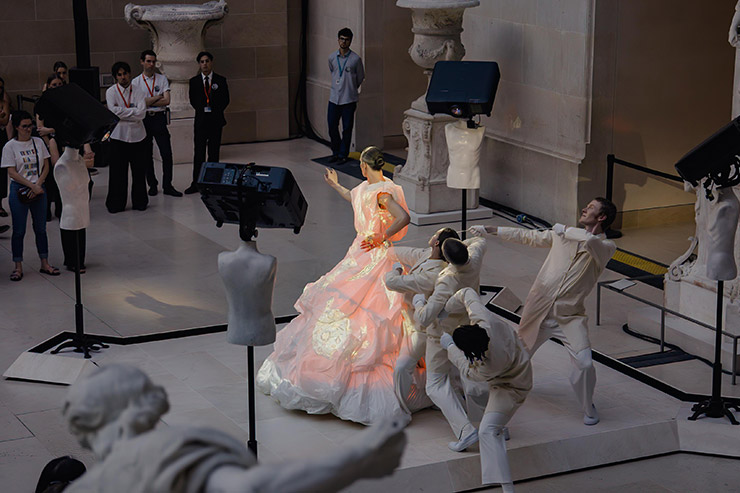
A critical design challenge was the handoff between projection and lighting. In Act I, as the projection-mapped red gown dissolved to reveal the white dress beneath, the visual effect could not simply end at the edge of the projection footprint. As Roth left the mapped zone and moved through the venue, tracked lighting seamlessly assumed the glowing quality established by the projection, sustaining the illusion in full without a visible break. This live handoff, coordinated in real time between the Disguise media servers and the lighting system, was one of the most technically demanding moments of the performance.

The performance window added further complexity. With ambient evening light filtering through the Cour Marly’s glass roof, the lighting had to be designed to read against residual natural light rather than darkness, requiring precise calibration of intensity and color to complement rather than fight the conditions.

The result was a lighting system that functioned less like traditional theatrical illumination and more like a responsive, intelligent layer of the performance itself, one that tracked, adapted, and transformed in lockstep with the performer across all three acts.

Lumen & Forge served as both the technical integrator and creative originator of all visual content, developing original video for each act directly from the Louvre’s permanent collection, then delivering it through a fully real-time projection and tracking system built around all three moving garments.

The visual infrastructure comprised 10 Panasonic PT-RQ50K 4K projectors totaling 500,000 lumens, driven by 5 Disguise VX 4+ media servers handling real-time playback, projection mapping, spatial re-mapping, and live content deformation. BlackTrax optical tracking provided continuous positional and rotational data on every performer-worn surface, feeding directly into Disguise’s live environment to keep all mapped content spatially locked to moving, flexible structures.

For Act I, the team sourced the red Galliano dress from the Louvre’s fashion collection and digitally reconstructed it as a high-resolution 3D texture, rendered in projection onto the white physical gown. The content was then animated to melt away in real time, revealing a glowing white dress beneath, before tracked lighting carried the effect forward as Roth moved through the space.
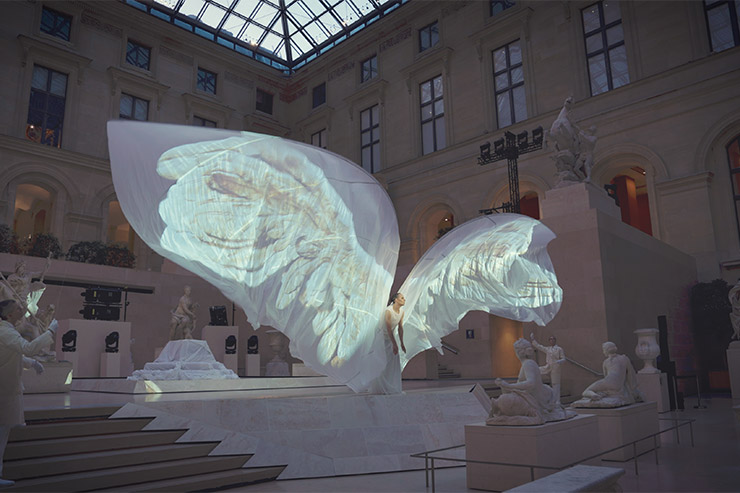
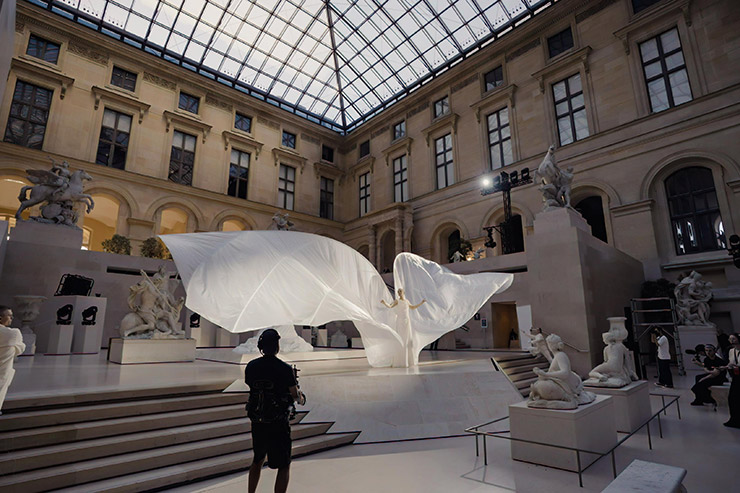
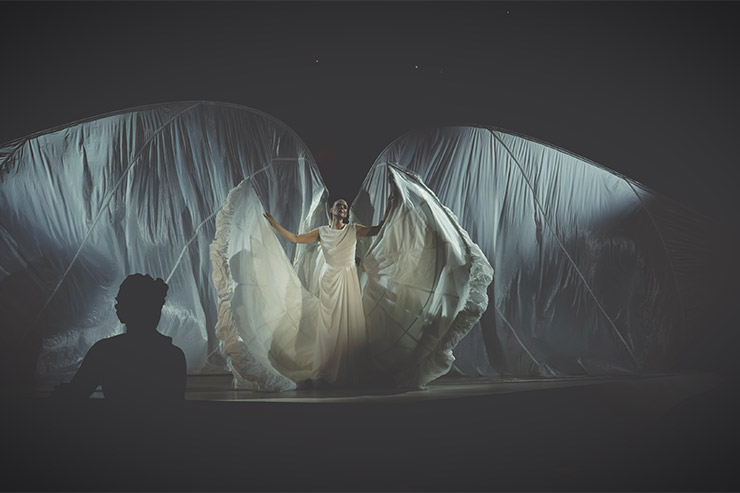
For Act II, 49 wing depictions were sourced from across the Louvre’s collection, spanning paintings, sculptures, and ancient artifacts. Each was individually animated with a custom entry sequence designed to honor its source material, then tracked and projected dynamically across the 44-foot physical wing span in real time.

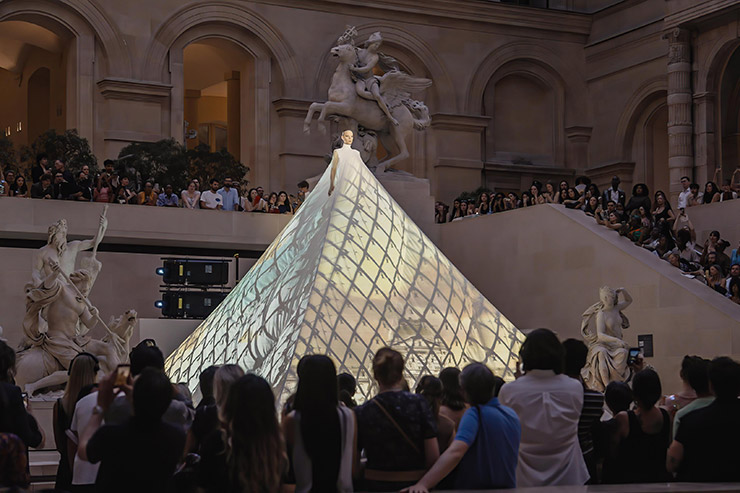
For Act III, 25 sky images were curated from Louvre collection works, artistically edited to isolate their most vibrant portions, then composited onto a wireframe of the Louvre Pyramid and animated into a compressed 24-hour day-to-night cycle lasting three minutes, a visual meditation on time told through centuries of art.

Underpinning all three acts was a first-of-its-kind real-time soft-body simulation pipeline, which allowed projection content to deform naturally with moving fabric and flexible structures, maintaining spatial accuracy despite garment motion, flex, and drift. No architectural surfaces were used as projection canvases; all media was mapped exclusively to performer-worn elements in compliance with the Louvre’s conservation standards.

The staging for Radical Acts of Unrelenting Beauty was defined by an absence of conventional infrastructure. Operating under the Louvre’s strict conservation requirements, the production was prohibited from attaching rigging, truss, or structural elements to the building itself. Every system, including projection, lighting, and tracking, had to be ground-supported, self-contained, and entirely non-invasive to the architecture.

Factioned designed and hand-fabricated all three wearable apparatuses: the gown, the 44-foot wingspan, and the 20-foot-wide, 16-foot-tall pyramid. Each structure was engineered from the outset to serve a dual purpose, functioning as both a performance costume and a precision projection surface. This meant integrating embedded BlackTrax tracking markers, structurally stable yet projection-friendly surface treatments, and mechanical systems that allowed Roth to wear, move in, and ascend into structures of considerable scale and complexity.

The pyramid in particular presented significant staging demands. As a wearable structure nearly the height of a two-story building, it required a mechanical solution for Roth to ascend into it during performance, while maintaining a surface geometry precise enough for real-time projection mapping to remain accurate throughout. The engineering had to account for both the structural integrity of the piece and the performer’s safety and mobility within it.

Projector and lighting positions were established from ground-supported towers and rigs, positioned to deliver optimal throw angles across all three acts without encroaching on the performance space or obstructing sightlines. The layout had to accommodate the dramatically different spatial footprints of each wearable, from the vertical sweep of the wings to the angular planes of the pyramid, while keeping every surface within the tracking and projection envelope at all times.

The result was a production infrastructure that was entirely self-sufficient within the venue, leaving no permanent trace on one of the world’s most protected cultural spaces, while supporting a performance of considerable physical and technical scale.

The defining special effect of Radical Acts of Unrelenting Beauty was not a single moment but a continuous one: the seamless, real-time fusion of a moving human body, wearable structures of extraordinary scale, and living visual content that tracked, deformed, and responded to every movement without interruption across all three acts.

At the core of this was the BlackTrax optical tracking system, deployed across Roth’s body, face, gown, wings, and pyramid simultaneously. BlackTrax fed continuous positional and rotational data into the Disguise VX 4+ media server environment, which used that data to keep projection content spatially locked to every performer-worn surface in real time. As Roth moved, turned, raised the wings, or ascended into the pyramid, the visuals moved with him, with no latency, no drift, and no loss of registration.

This tracking pipeline was extended into a first-of-its-kind soft-body simulation system that allowed projection content to deform naturally with moving fabric. Rather than treating the gown as a rigid mapped surface, the system modeled the physical behavior of the garment in real time, bending and flexing the visual layer to match the movement of the cloth beneath. The result was projection that felt alive on the body rather than painted onto it.

The most visually striking application of the tracking system came at the close of Act I. As the projection-mapped red gown dissolved to white and Roth stepped beyond the projection footprint, the glowing effect did not end. Tracked lighting, fully integrated with the same positional data driving the projection, assumed the visual seamlessly, following Roth through the venue and sustaining the illusion long after the projectors could no longer reach him. To the audience, there was no handoff. The effect simply continued.

Across all three acts, tracking transformed the wearable structures from projection surfaces into responsive performance instruments, each one precisely registered to the performer’s body and animated in lockstep with his movement through one of the world’s most celebrated architectural spaces.

Conservation Constraints The Louvre’s conservation requirements prohibited any projection onto architectural surfaces and any attachment of rigging or structural elements to the building. The team responded by designing the entire production around performer-worn surfaces, with all projection mapped exclusively to mobile, wearable elements. Ground-supported projection and lighting towers were engineered to provide full coverage without any contact with the museum structure.

Evening Lighting Conditions The performance window meant ambient evening light was filtering through the Cour Marly’s glass roof throughout the event. To overcome this, Lumen & Forge deployed 10 Panasonic PT-RQ50K projectors totaling 500,000 lumens, an extraordinary output level for a performance of this type, while the lighting design was calibrated specifically to read against rather than fight the residual natural light conditions.

Real-Time Projection on Soft, Moving Garments Projecting onto rigid architectural surfaces is a well-established discipline. Projecting onto flowing fabric and flexible structures worn by a moving performer in real time is not. To solve this, Lumen & Forge developed a custom soft-body simulation pipeline that allowed projection content to deform naturally with the garment’s movement, maintaining spatial accuracy across flex, fold, and motion drift. This is believed to be one of the first implementations of this approach at this scale.

System Integration Across Tracking, Projection, and Lighting With BlackTrax, Disguise, and the lighting control system all operating simultaneously and interdependently, the integration demanded an exceptionally high level of coordination. The live handoff in Act I, where projection dissolved and tracked lighting seamlessly assumed the visual effect as Roth moved off the projection footprint, required precise calibration and extensive rehearsal to execute without a visible seam.

Scale and Complexity of Wearable Structures Each of the three wearable apparatuses presented its own fabrication and engineering challenges. The 44-foot wingspan and 20-foot pyramid had to be structurally sound, performer-safe, and mechanically operable, while also meeting the surface precision required for real-time projection mapping. Factioned’s design and fabrication process addressed these constraints through close technical collaboration with Lumen & Forge from the earliest stages of development

Radical Acts of Unrelenting Beauty represents a genuine advance in what live performance technology can do, and where it can be done.

The project combined, for the first time at this scale, real-time soft-body projection mapping on moving garments, full-body optical tracking, responsive lighting integration, and original content drawn from one of the world’s great cultural institutions, all deployed within a UNESCO-protected venue under ambient evening light filtering through a glass roof. Any one of those conditions would present a significant challenge. Together, they defined a production that had no direct precedent.

The creative ambition matched the technical achievement. Every visual element was developed from the Louvre’s own permanent collection, reconstructed, animated, and projected back into the space as living performance material. The red Galliano dress, the 49 wing depictions spanning centuries and media, the compressed day-to-night skyscape built from 25 works of art: these were not decorative additions to a performance. They were the performance, inseparable from the movement of the performer and the meaning of the work.

The soft-body simulation pipeline developed for this project opens a new frontier for projection-mapped performance. The seamless handoff between projection and tracked lighting demonstrated a level of system integration rarely achieved in live environments. And the entire production was executed without leaving a single mark on a building that has stood for centuries.

This was not a project that adapted existing tools to a new context. It required new thinking, new development, and new collaboration across creative, technical, and institutional partners, resulting in something that had not existed before and could only have been made this way, in this place, on this night.