
Oceano Odyssey – Mission Pelagos


ProjectOceano Odyssey - Mission PelagosLocationMonacoLighting Designer8'18, ParisAcousticianArtisans d'idées, Erwan Girma, MarseilleSystems IntegratorMusée océanographique de MonacoSubmitted ByMusée océanographique de Monaco

Oceano Odyssey was commissioned by the Oceanographic Museum of Monaco as the central installation of its “Mediterranean 2050” programme, replacing the previous immersive and interactive experience. The brief was to transform the historic Salle de la Baleine into a fully integrated audiovisual environment delivering a scientifically rigorous yet emotionally compelling underwater journey, without individual devices and without compromising the protected architecture.

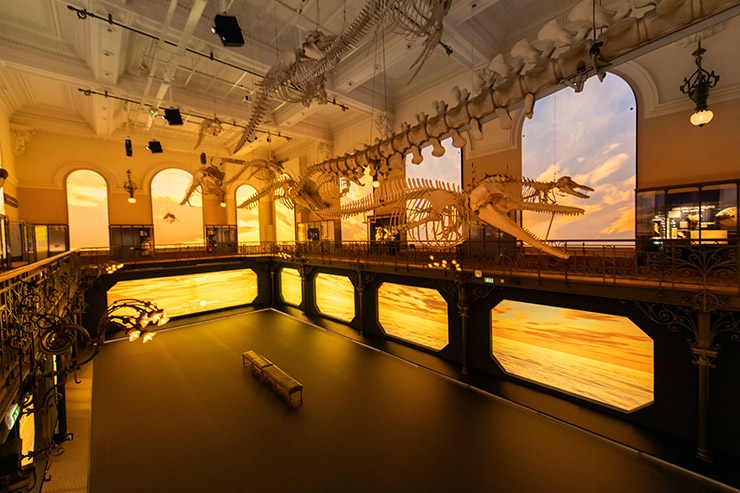
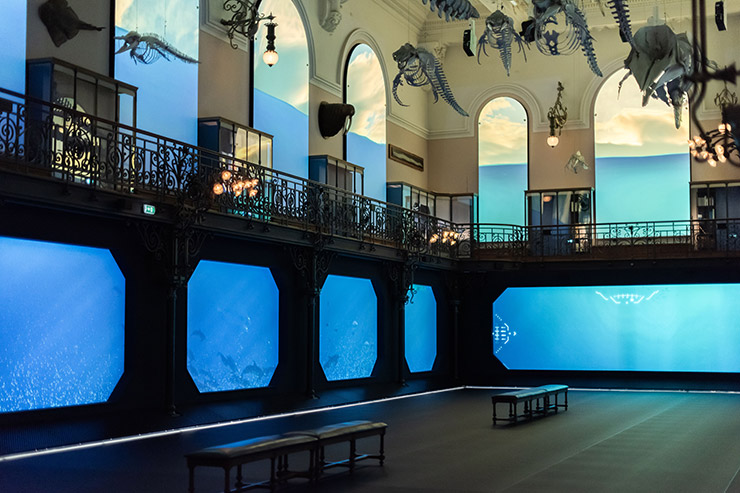
The result is a 310 m² projection-mapped environment powered by 27 4K laser projectors and a robust media infrastructure, featuring photorealistic CGI content developed in Unreal Engine that transforms the hall into a fully immersive scientific vessel.

The audio soundtrack was conceived as a fully integrated spatial system designed to reinforce immersion and narrative coherence. From the outset, sound was treated as an active storytelling layer, shaping perception and emotional progression throughout the experience.

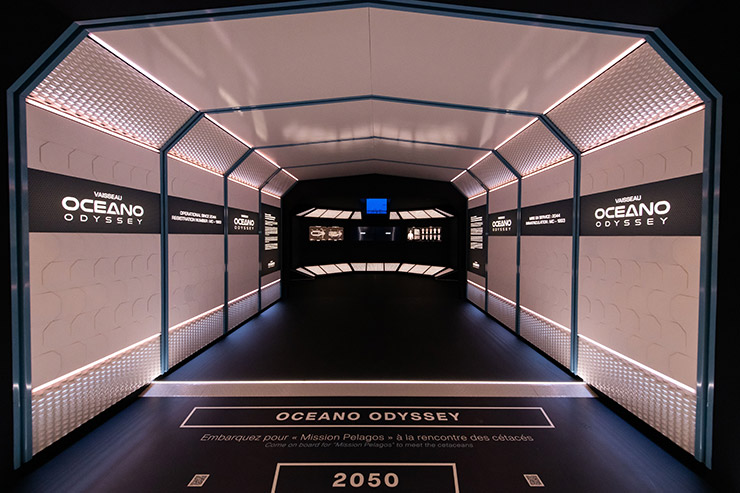
The immersive approach starts with the entrance tunnel, where eight Frenetik Spik 3 PoE loudspeakers providing localised proximity sound, creating a transitional acoustic environment that prepares visitors for the main space.

An additional distributed network of 24 Frenetik Spik 3 PoE loudspeakers was installed around the perimeter of the Salle de la Baleine at approximately three-metre intervals. Suspended beneath the upper-level walkway, they ensure precise coverage of the ground floor while preserving the visibility of the historic architecture. Six Alto TX212 powered subwoofers provide controlled low-frequency reinforcement, adding depth and physical presence without imposing structural stress on the building.

The use of PoE technology simplified installation by eliminating separate power cabling, while Dante compatibility enabled network-based signal distribution and efficient DSP configuration. The system is fully synchronised with central show control and media servers, ensuring frame-accurate alignment between projection and audio. Zoning, level management and low-frequency intensity are adjustable via the control interface, and remote access combined with scheduled maintenance supports long-term operational stability across extended daily opening hours.

Sound also structures the temporal arc of the experience. An original composed score was designed, using REAPER audio software. It was synchronised to the visual timeline, driving the progression of sequences. Studio-recorded voice performances, embodying the captain and her crew, are precisely spatialised and integrated within the musical framework. Dialogue, environmental soundscapes, music and underwater bioacoustic textures form a unified, time-coded sonic environment distributed across the networked system.

Our aim was, through calibrated spatialisation and controlled dynamics, that audio becomes a navigational and emotional layer that reinforces immersion and transforms the historic hall into the living interior of the Oceano Odyssey vessel.

Lighting was conceived as a scenographic layer supporting immersion, while carefully integrating the constraints of a protected architectural space. A primary challenge lay in controlling the significant daylight entering through the historic windows. This ambient light had to be carefully reduced to achieve stable projection conditions across the 310 m² mapped surface, without altering or obscuring the listed architecture.

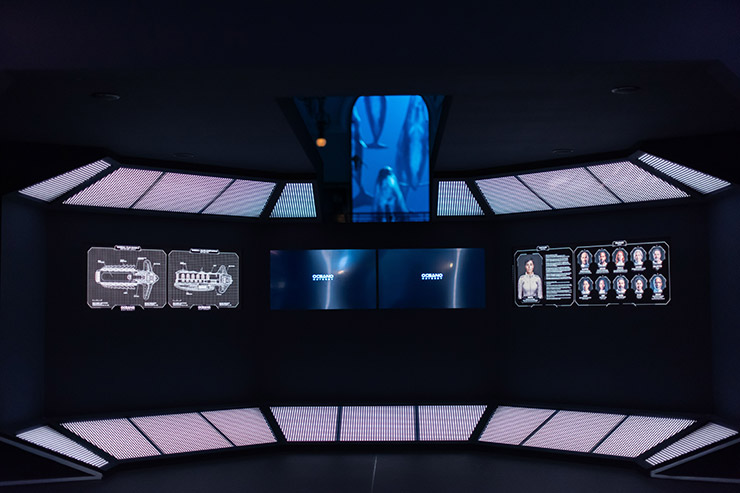
A discreet and precisely calibrated lighting system was introduced to support both immersion and orientation. Linear LED fixtures with diffused output and DALI dimming were integrated within the cockpit structure and along architectural edges, providing subtle guidance while preventing spill onto projection surfaces. In selected areas, controlled backlighting enhances depth perception and reinforces the spatial composition without increasing overall luminance.

Within recessed technical elements, dimmable LED panels were specified to ensure even, glare-free illumination. Cavity depths and diffusion were carefully calculated to avoid hotspots and maintain visual comfort, while allowing independent zoning and fine control in relation to projection contrast and operational requirements.

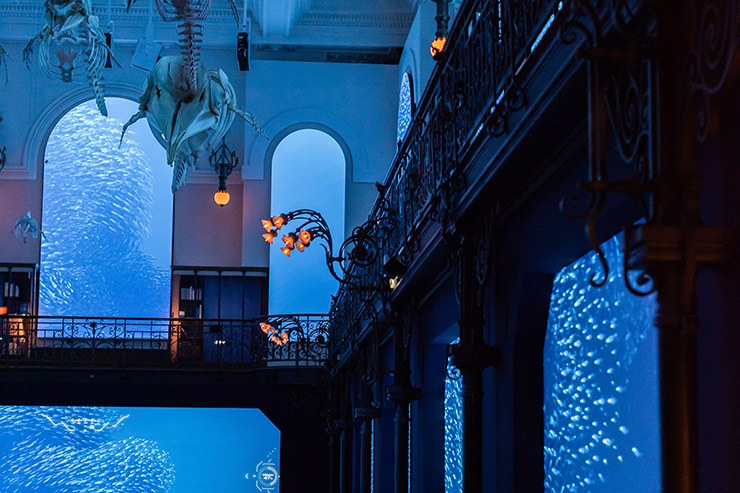
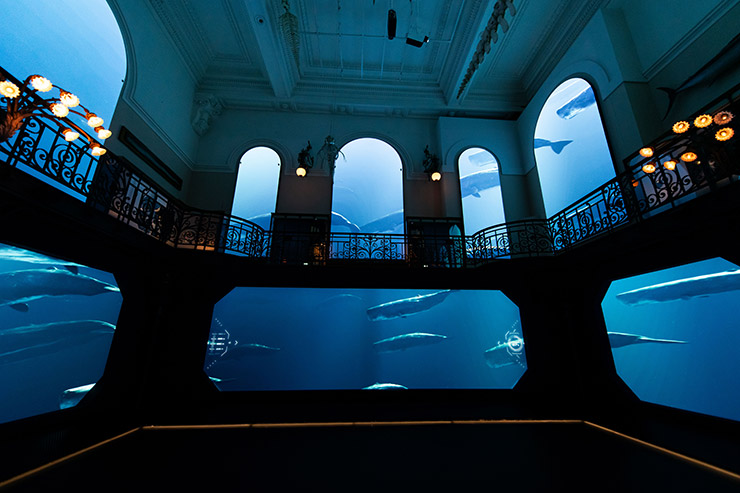
The historic wall sconces were preserved and retrofitted with low-intensity warm LED sources. Rather than competing with the projection, they provide a restrained architectural glow that maintains the character of the hall while avoiding light pollution.

Stair access to the mezzanines required compliant safety illumination. Low-level integrated lighting was introduced to meet ERP public standards, ensuring adequate lux levels for circulation without compromising the scenographic darkness of the main space.

The result is a precisely balanced lighting environment in which immersion, heritage integrity and operational safety coexist within a cohesive visual atmosphere.

The visual system was engineered to transform a protected heritage hall into a fully immersive projection environment without invasive architectural intervention. The Salle de la Baleine presents complex spatial constraints: suspended Mediterranean marine mammals’ skeletons, non-planar surfaces, significant vertical volume and strict conservation requirements.

The installation comprises 27 Epson 4K laser projectors (EB-PU1008 and EB-PU2010), 15 were ceiling-mounted, and 12 operate in rear projection, delivering a calibrated multipoint projection system across 310 m² of architectural mapped surfaces.

Laser projection was deliberately chosen over LED screens in order to preserve the visual integrity of the historic space and for its long operational lifespan. A combination of short – and long – throw optics was selected to adapt to varying projection distances and sightlines. Edge blending and geometric warping were carefully configured to ensure uniform brightness, colour stability and seamless continuity across walls and structural volumes.

The media architecture is based on five Modulo Pi PRO6 servers, coordinated by a PRO4 master unit, with an additional PRO6 spare to ensure redundancy. Each projector is fed by BrightSign players.

Show control is run through a Medialon programme operating on a custom-built PC, enabling frame-accurate playback, automated daily scheduling and stable performance over an average of nine operational hours per day, currently maintaining 100% uptime.

A network-based tablet control interface enables direct individual scene triggering, playback override and show reset, providing real-time operational flexibility for education, events and filming without impacting core system stability.

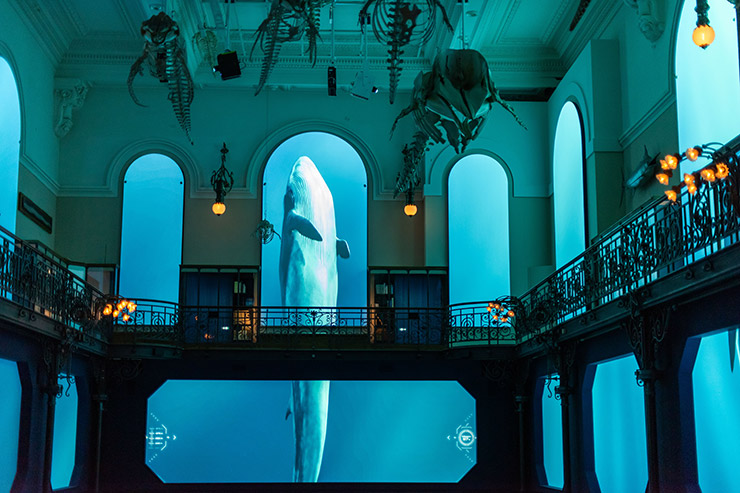
Content was developed using Unreal Engine to generate a dynamic digital marine protected area exceeding 300 km². Approximately thirty Mediterranean species – representing over 866,000 individual assets – were modelled and animated within multiple marine environments. The result is a continuous, high-resolution visual field that envelops visitors without the need for individual devices.

Through precise calibration, synchronised processing and architectural integration, the visual system transforms the historic hall into a cohesive immersive vessel while meeting the technical demands of long-term museum operation.

The trussing and staging strategy was developed to address the structural and conservation constraints of the historic Salle de la Baleine. Integrating 27 laser projectors within a protected heritage environment required careful coordination with the suspended Mediterranean marine mammals’ skeletons and existing architectural fabric.

Fifteen projectors were suspended at ceiling level in close proximity to the skeletal structures. Load calculations were carried out with precision to the kilogram to ensure full compliance with safety standards while remaining within the building’s structural limits. Beam paths were meticulously aligned to prevent physical contact or visual interference.

Where necessary, minor adjustments were made to the vertical positioning of certain skeletons in consultation with conservation authorities, ensuring optimal projection geometry without compromising heritage presentation. Power and signal cabling were routed discreetly along the upper structural framework to avoid invasive intervention.

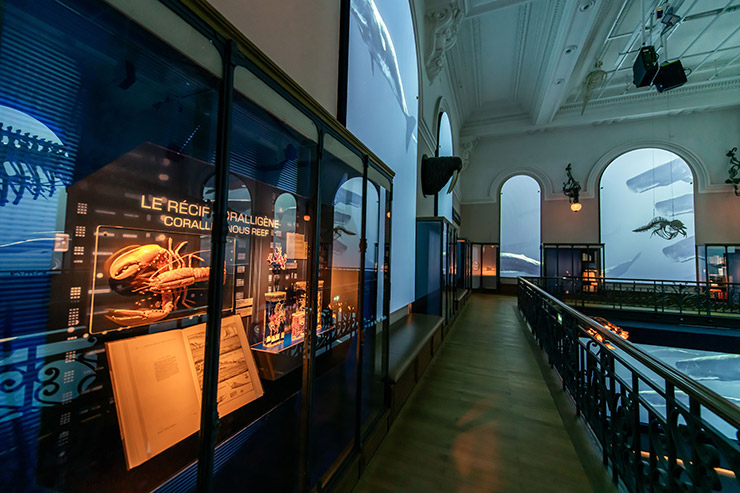
Beneath the mezzanines, twelve additional projectors were installed to operate in rear projection onto custom-designed porthole structures. This configuration required bespoke support frames engineered to rest on fragile, century-old display vitrines without drilling or permanent fixing. The frames are self-supporting and distribute weight in a controlled manner, preserving the integrity of the original furniture while maintaining structural stability.

All rigging solutions were conceived as reversible and non-destructive. The installation phase extended over three months and involved continuous collaboration between structural engineers, AV integrators and the museum’s conservation team.

The primary challenge lay in bringing together three distinct yet interdependent dimensions: a historic, heritage-listed space, a contemporary immersive installation, and a demanding scientific narrative. The experience had to sit naturally within the architecture while giving visitors the convincing sensation of boarding a vessel and setting out on a subaquatic exploration.

Several specific challenges shaped both design and delivery. One key aspect was the synchronisation of projections across the twenty-six windows of the hall, preserving the illusion of looking out through portholes onto the Mediterranean. At the same time, the installation had to function seamlessly for a moving audience, maintaining a continuous sense of immersion regardless of viewpoint, so that each visitor feels fully on board.

The narrative was conceived as an uninterrupted sixteen-minute descent, a continuous underwater travelling shot guiding visitors through a succession of Mediterranean ecosystems. Achieving this required the creation of a large-scale, living digital environment capable of conveying both the richness and the complexity of marine life.

At the core of the project was a constant ambition: to let the technology recede from view, allowing exploration, wonder and understanding of the living world to take centre stage.

Oceano Odyssey deserves a MONDO-DR Award because it redefines what immersive engineering can achieve inside a protected heritage space.

The Salle de la Baleine is not a black box. It is a monumental historic volume inhabited by suspended Mediterranean marine skeletons and shaped by architectural grandeur. Many projects would conceal such a space. Oceano Odyssey does the opposite. It embraces it. Projection was chosen over LED walls to preserve spatial depth and minimise structural impact. The hall itself becomes the vessel. Its verticality becomes oceanic depth. Its skeletons become silent witnesses within the scenography.

Within this context, the project demonstrates a highly controlled integration of audiovisual technologies, combining multi-surface projection, networked media systems and precise calibration to operate within strict structural and conservation constraints. Each technical decision was guided by the need for reliability, reversibility and long-term performance in a demanding museum environment (+650 000 visitors/year).

The experience brings together cutting-edge photorealistic CGI environments, scientifically grounded content and a carefully structured narrative progression, creating a coherent journey accessible without individual devices.

This convergence of scenography, visual technologies and scientific communication reflects a renewed approach to bringing heritage, contemporary creation and awareness of marine conservation into dialogue. It sets a new benchmark for how immersive environments can transform iconic spaces without diminishing their identity – and in doing so, raises the standard for the industry as a whole.