
Kids’ Atelier


ProjectKids' AtelierLocationParis, FranceInstallerCadmosSubmitted ByModulo Pi

The Kids’ Atelier at Atelier des Lumières is an interactive extension of the venue’s immersive exhibitions, designed to engage younger audiences. Commissioned as part of a family-oriented cultural offering, the brief was to design an engaging, high-capacity experience where children can actively participate.
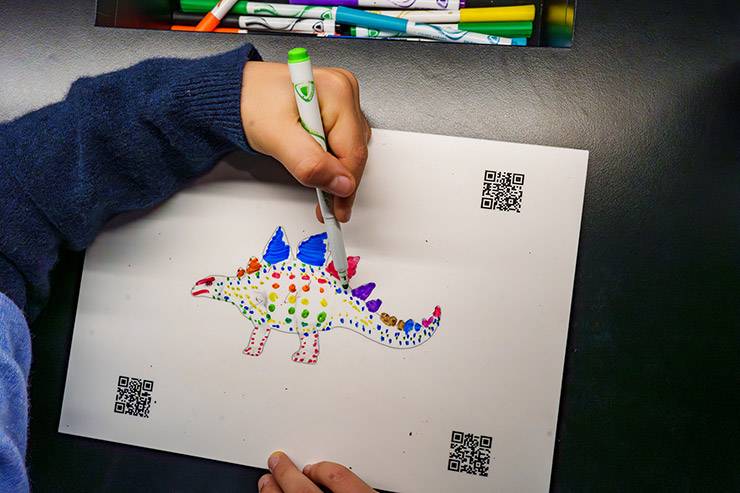
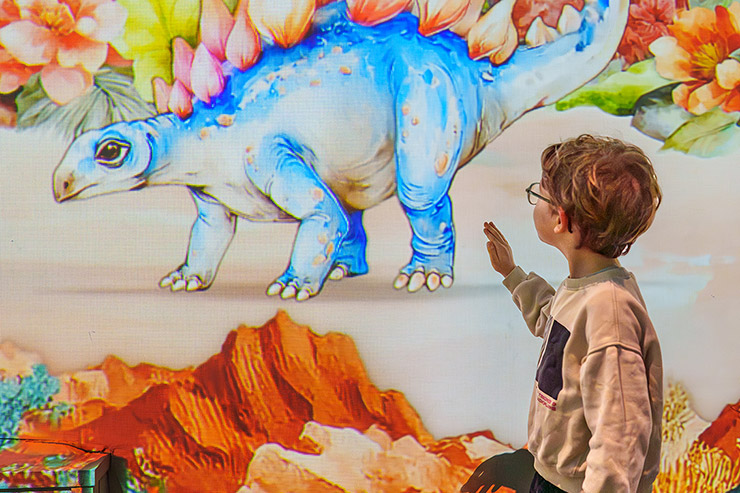
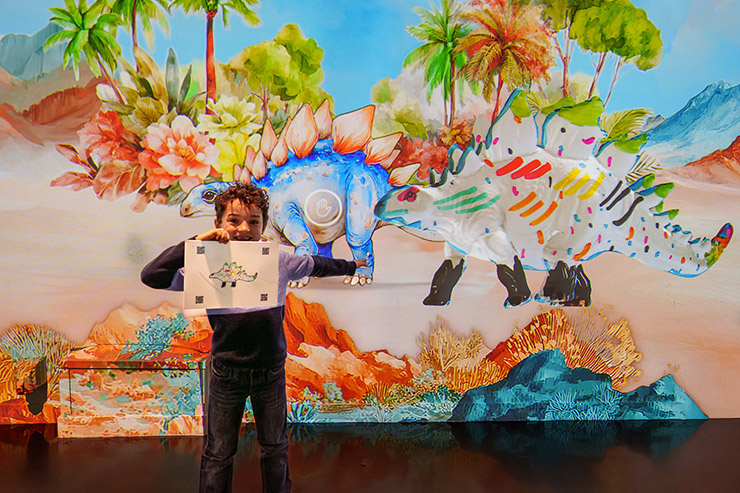
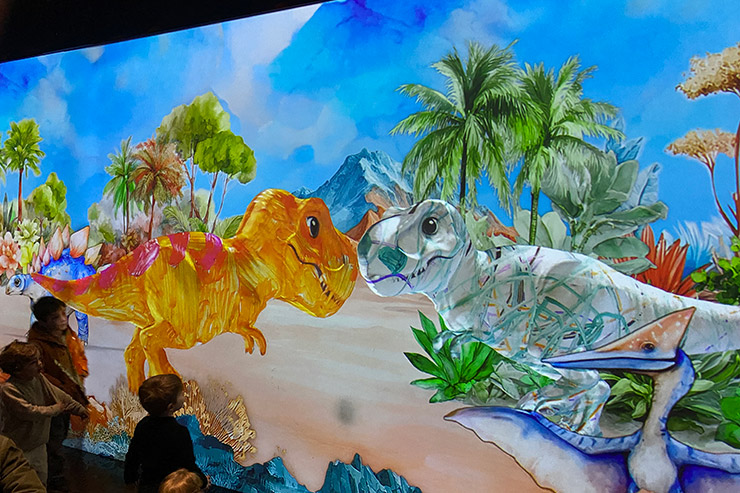
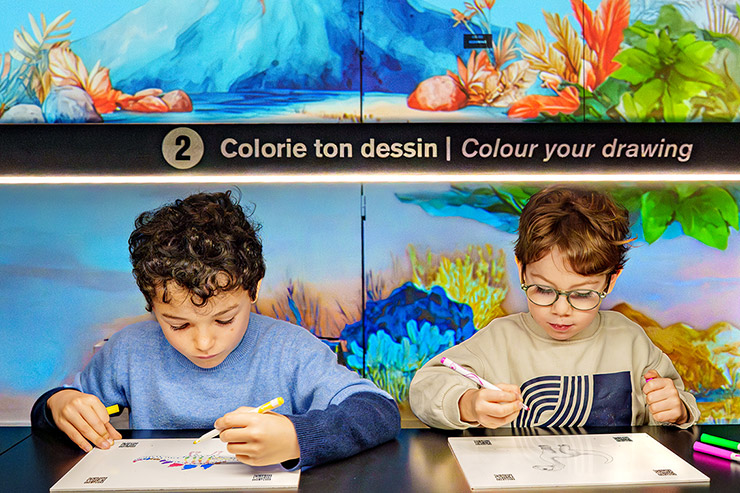
The solution enables children to color illustrated templates inspired by the exhibition theme, scan them, and instantly see their creations animated and projected at large scale within a shared immersive environment. The installation needed to be intuitive, robust, and seamlessly aligned with the exhibition of the main hall, while delivering a meaningful, playful introduction to immersive art.

The audio design of the Kids’ Atelier complements the immersive visuals. It delivers a balanced soundscape that enhances immersion without overwhelming the interactive experience.
A distributed loudspeaker system ensures even coverage across the space. The soundtrack combines ambient atmospheres with playful sonic cues that subtly reinforce the video projection and user interactions. The result is an immersive yet controlled audio environment that supports exploration and enhances engagement.

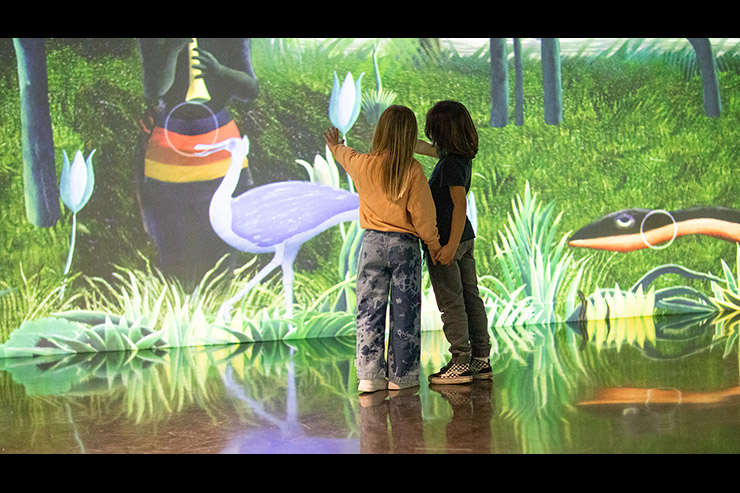
The Kids’ Atelier is a 160m² immersive space designed as an extension of Atelier des Lumières main hall, echoing its current exhibition theme through a more playful and participatory approach tailored to younger audiences. Rather than replicating the main experience, the installation invites visitors to actively contribute to the visual environment.
The room is fully surrounded by projection, powered by 8 × Epson EB-PU2010 video projectors. The system is driven by the Modulo Kinetic media server, comprising one Kinetic Designer workstation and two Kinetic V-Node servers. Together, they deliver a seamless immersive display spanning a 39-meter-wide surface with a projection height exceeding 3 meters.
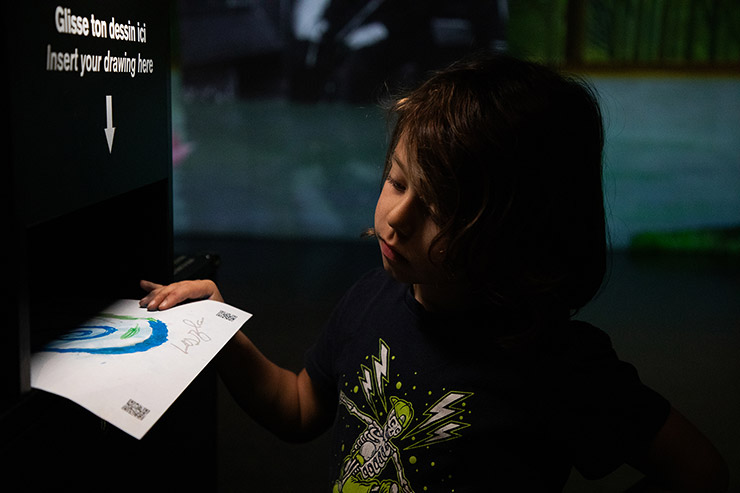
At the core of the experience are several coloring stations where visitors can create their own drawings. Once completed, each artwork is scanned and immediately integrated into the projected world. The interactive universe was designed and developed by Spectre Lab, while the real-time integration of user-generated content is handled by Modulo Kinetic.
Each template includes four unique QR codes. When scanned, a Modulo Bridge establishes communication between the scanner and the media server. Modulo Kinetic detects the QR codes, identifies the template, and automatically associates the scanned drawing with the appropriate media and animation.
The image is then processed in real time, mapped as a texture onto a pre-rigged 3D model, and injected into the live projection. Within seconds, the drawing appears animated within the environment, retaining the unique colors and input of its creator.
This workflow is powered by Modulo Kinetic’s node-based compositing engine, enabling real-time animation and the seamless blending of 2D and 3D content via its timeline system.
Overall, the installation combines large-scale projection, real-time processing, and dynamic content integration to create a highly engaging and participatory immersive experience.

The experience at the Kids’ Atelier goes far beyond immersive projections and the real-time display of audience-colored drawings. Visitors can actively interact with the projection through touch. Various elements of the walls invite participants to reach out with their hands, triggering dynamic visual and sound animations. This interactivity also extends to scanned drawings—once they appear on the wall, touching them sets off different animated responses.
The system relies on four 2D Hokuyo LiDAR sensors, mounted at the top of each wall and emitting invisible laser beams. The Modulo Kinetic media server, which supports this type of LiDARs, receives the sensor data in real time, and triggers the programmed interactive animations instantly.
This playful, hands-on approach transforms the visitor experience, turning spectators into active participants who engage with the installation.

The first challenge was ensuring an intuitive visitor journey. The audience, including children, needed to be able to understand and enjoy the experience immediately, from coloring a template to seeing their artwork appear on the walls. The interaction design had to be simple, engaging, and self-explanatory, so that visitors could participate without guidance.
Furthermore, to make the experience feel natural and seamless, the time between scanning a drawing, processing it, and seeing it animated on the projection had to be imperceptible. Touch interactions with the projected environment also required near-instantaneous response, ensuring a smooth, engaging, and credible interactive experience.
Robustness and reliability were also major priorities. The system operates intensively, seven days a week, with continuous visitor interaction. Modulo Kinetic ensures stable real-time processing and content management, allowing the system to handle heavy usage consistently without interruption.
Finally, future-proofing was essential. Themed exhibitions are updated more frequently than in the past, and the system needed to accommodate new content quickly. Thanks to Modulo Kinetic’s modular architecture and efficient workflow, new interactive templates and animations can be integrated with minimal preparation time, enabling the Kids’ Atelier to evolve alongside the main exhibitions without disrupting operations or creating an overly complex management process.
By leveraging Modulo Kinetic for real-time content integration, low-latency rendering, and streamlined workflow management, the installation successfully addresses these key challenges while delivering a smooth, engaging, and sustainable interactive experience for all visitors.

The Kids’ Atelier at Atelier des Lumières represents a significant evolution in immersive audiovisual design by placing user creativity at the center of the experience. Rather than delivering a fixed narrative, the installation transforms visitors—particularly children—into active contributors, redefining the relationship between audience and content.
Technically, the project demonstrates excellence in the integration of real-time processing, projection mapping, and interactive technologies at scale. The seamless transition from physical drawing to animated projection, achieved within seconds, showcases a high level of system design and execution.
Importantly, the project expands the accessibility of art experiences. By designing an interaction model that is intuitive and inclusive, it engages audiences who may not typically connect with digital art installations.
The Kids’ Atelier is not only a technical achievement, but a meaningful innovation in audience engagement—demonstrating how audiovisual technology can foster creativity, participation, and emotional connection.