
BIESSE M-HUB


ProjectBIESSE M-HUBLocationVarious, WorldwideInstallerNextdomus SrlSubmitted ByNextdomus Srl

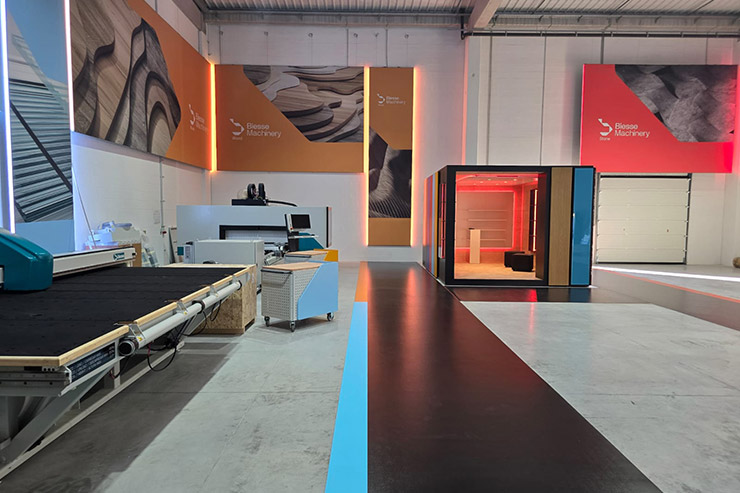
The BIESSE M-HUB project represents a groundbreaking initiative that redefines the concept of an industrial showroom through a seamless fusion of architecture, technology, and sensory experience.
Commissioned by Biesse Group, a global leader in machinery and automation for material processing, the M-HUB was conceived as a phygital environment — blending physical and digital experiences — to express the company’s innovation, heritage, and forward-looking vision.

Next Domus was entrusted with the design, programming, installation, and commissioning of all audio, video, and lighting systems across six international hubs: Pesaro (Italy), Lyon (France), Porto (Portugal), Toronto (Canada), Sydney (Australia), and Osaka (Japan).

Audio was carefully designed to support both immersive storytelling and clear communication across the open architectural spaces of the M-HUB. Next Domus implemented a multi-zone audio distribution system using K-Array loudspeakers and Shure DSP processing to ensure balanced sound coverage and excellent speech intelligibility throughout the venue.

The system allows different areas of the hub to operate independently while remaining fully integrated within the overall AV ecosystem. For example, background soundscapes can accompany visual storytelling in exhibition areas while presentations or live demonstrations take place in the stage or meeting zones without interference.

Through Crestron control, audio levels, routing, and presets can be managed easily from touch panels or automated sequences. During presentations, the system automatically adjusts sound levels and spatial distribution to match the visual content and lighting scenes, reinforcing the immersive atmosphere of the environment.

This integrated approach ensures that sound becomes a natural extension of the storytelling experience rather than a standalone technical layer. Whether visitors are exploring product displays, attending a live demonstration, or participating in a presentation, the audio system provides clarity, consistency, and emotional depth that enhances the overall visitor journey.

Lighting played a fundamental role in shaping the immersive identity of the BIESSE M-HUB spaces. Rather than functioning as a purely architectural element, the lighting system was designed as an active storytelling tool capable of transforming the atmosphere of each environment in real time. Next Domus implemented a Crestron-integrated lighting control infrastructure using DALI interfaces, allowing precise control over intensity, color temperature, and scene transitions throughout the entire showroom.

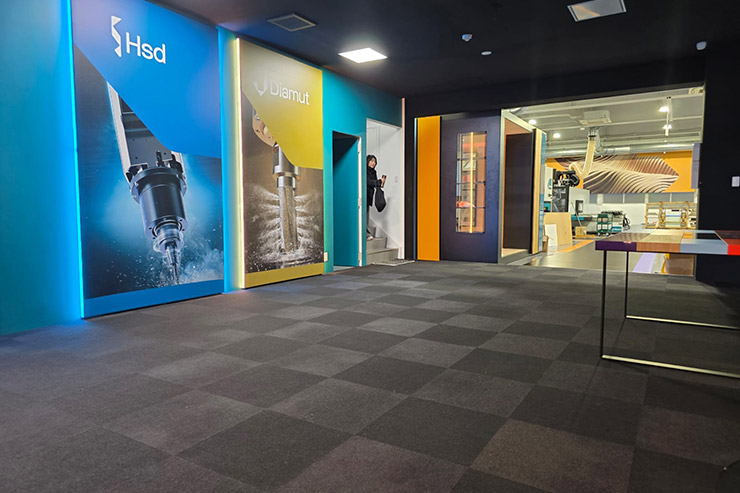
Each zone of the hub — including the Welcome Area, Interactive Box, Stage, and meeting spaces — was programmed with predefined lighting scenes synchronized with audiovisual content. This approach enables lighting to dynamically respond to presentations, product demonstrations, and digital storytelling sequences. For example, when a presentation begins, the lighting automatically adjusts to guide visitors’ attention toward key visual elements such as projection surfaces or LED displays.

The lighting design also enhances the architectural features of the space, emphasizing materials, machines, and pathways while maintaining a clean and elegant visual language aligned with the Biesse brand identity. By integrating lighting cues with video playback and audio environments, the system creates seamless transitions between different experiential moments.

Ultimately, the lighting system contributes to a cohesive multisensory experience, supporting both functional requirements and emotional engagement. Through intelligent automation and centralized control, the system ensures consistent performance across all international hubs while allowing local teams to easily adapt scenes for events, demonstrations, or daily operation.

The visual infrastructure was designed to deliver a powerful and flexible digital storytelling platform capable of presenting Biesse’s technology and innovation in a highly engaging way. Next Domus implemented a Crestron DM-NVX AV-over-IP architecture that allows high-resolution video signals to be distributed across multiple displays, projection systems, and LED walls throughout the hub.

This network-based approach eliminates the limitations of traditional AV distribution, providing low-latency 4K video transmission over standard Ethernet infrastructure. Content can be routed dynamically to different areas of the showroom, enabling simultaneous presentations, immersive visual environments, and synchronized product demonstrations.

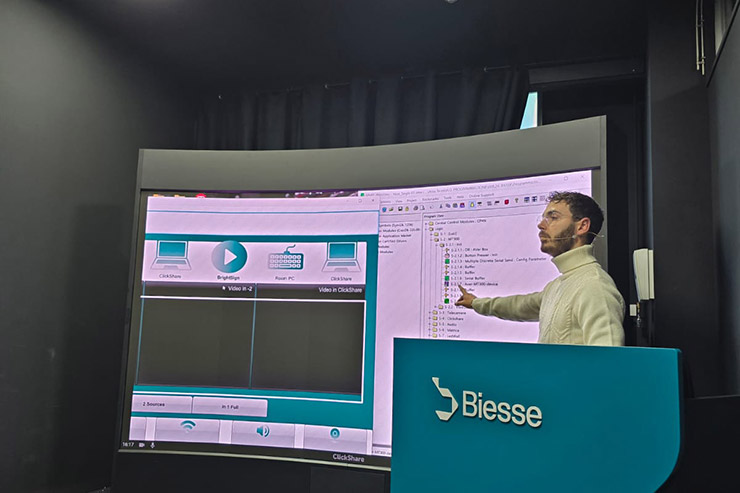
Large-scale projection surfaces and high-definition displays play a central role in communicating Biesse’s narrative. Visual content ranges from cinematic brand storytelling to technical demonstrations of machinery and materials. The system allows operators to instantly switch between content sources, adapting the visual environment to different scenarios such as guided tours, training sessions, or live events.

By combining flexible content management with Crestron automation, the visual system ensures that every visitor experiences a cohesive and impactful narrative. The result is a visually dynamic environment where digital media and architectural space merge seamlessly, transforming the showroom into an interactive communication platform that reflects the technological excellence of the Biesse brand.

To elevate the experience beyond traditional showroom environments, Next Domus integrated a range of automated audiovisual effects that synchronize lighting, video, and sound into a unified sensory performance. These special effects are orchestrated through Crestron control logic, enabling seamless transitions between different experiential moments throughout the hub.

Automated sequences allow multiple technologies to respond simultaneously to specific triggers. For example, when a product presentation begins, projection mapping activates on large surfaces while lighting scenes shift to highlight the displayed machines, and audio cues introduce the narrative. These synchronized transitions create a cinematic effect that captures visitors’ attention and reinforces the storytelling dimension of the space.

The system also supports dynamic scene changes for events and demonstrations. Operators can trigger predefined scenarios that transform the environment instantly — adjusting brightness levels, activating media content, and coordinating audio playback in perfect harmony. This capability allows the space to adapt effortlessly to different functions, from guided tours and training sessions to live corporate events.

By combining automation, precise control programming, and scalable system architecture, these special effects transform the M-HUB from a static showroom into a living experiential environment. The technology remains invisible to the user, yet it continuously shapes the emotional and visual impact of the space, creating memorable interactions that reflect Biesse’s commitment to innovation and technological excellence.

The BIESSE M-HUB project was conceived from the client’s ambition to create a new generation of experiential showrooms — environments where innovation, design, and digital technology converge to express the essence of the Biesse brand.
Biesse sought to offer its global customers an immersive journey through the company’s technologies and materials, transforming each visit into an interactive storytelling experience that could be replicated across continents while maintaining the same level of quality, emotion, and technological excellence.
Next Domus was tasked with translating this vision into an intelligent environment in which audio, video, and lighting would not only enhance the architecture but also dynamically respond to the visitor experience. To achieve this, our team developed a fully integrated Crestron-based ecosystem that unified all AV and lighting systems across six international hubs.

Using Crestron TSW touch panels, DM-NVX AV-over-IP technology, and DALI lighting interfaces, we created a single digital infrastructure capable of controlling projection mapping, LED walls, sound distribution, and ambient lighting scenes through one intuitive interface. Each space — from the Welcome Area to the Interactive Box, Stage, and meeting rooms — was programmed with automated scenes enabling seamless transitions between demonstrations, presentations, and live events.

As the concept evolved, the system expanded beyond a traditional AV installation into a smart experiential platform. Additional features included dynamic lighting integration linked to content playback, multi-zone audio distribution using K-Array and Shure DSPs, custom Crestron user interfaces for local and remote control, and centralized monitoring across all six global hubs.

Despite the challenges of deploying identical installations across multiple continents — including regional technical variations, time-zone coordination, and strict synchronisation requirements — Next Domus implemented a centralized engineering workflow. All control logic, lighting configurations, and AV schematics were developed and tested in Italy before deployment.

The result is a globally synchronized network of intelligent experience centers where technology, architecture, and storytelling operate in perfect harmony.

It is not only a technological installation, but a global concept of intelligent environments — six interconnected experience centers where architecture, light, sound, and digital content merge into a single, living system controlled by Crestron.

This project transforms the traditional industrial showroom into a phygital stage — a space that learns, adapts, and communicates.

Unlike standard automation or AV integration projects, BIESSE M-HUB required a fully unified sensory ecosystem, scaled and replicated across six continents with absolute precision.

For the first time, Next Domus engineered a standardized Crestron architecture — including DM NVX AV-over-IP distribution, DALI lighting control, and custom automation code — that could be cloned and localized in different countries while maintaining an identical user experience.

This wasn’t just an integration challenge; it was a cultural and experiential innovation.

Each M-HUB blends local design with the same Crestron-based digital DNA, allowing visitors in Osaka, Toronto, or Lyon to live the same immersive brand experience.

The system’s flexibility, centralized control, and seamless global consistency mark a new benchmark in how intelligent spaces can be conceived and deployed worldwide.
Absolutely. The entire experience is built to evoke that “wow” moment from the instant a visitor enters.
• The immersive synchronization between lighting, projection, and sound — all orchestrated in real time by Crestron control logic — transforms each showroom into a dynamic storytelling environment.
• Lighting color and intensity shift automatically with the content and mood, creating cinematic transitions during product presentations or events.
• High-resolution LED walls and projection mapping, combined with precisely tuned audio zones, envelop the visitor in a multisensory narrative.
• The Crestron TSW touch interfaces provide an elegant, intuitive way to command complex systems with a single gesture — everything “just works,” invisibly, perfectly.
• And perhaps most impressively, the system delivers this same flawless experience on six continents simultaneously, proving the scalability and reliability of Crestron’s technology and Next Domus’s design.

The result is not simply a showroom — it’s a living, intelligent brand environment, where every detail, light, and sound is part of an orchestrated global experience.